Do You Need a Data Model?
A data model is a simplified representation of the underlying database schema. The data model reorganizes the database tables and columns to provide a simplified entity-attribute interface for users who are designing Dashboards. For example, the ‘Order Model’ data model below organizes attributes into a set of five entities, ‘Customer’, ‘Order’, ‘Product’, ‘Salesperson’, and ‘Supplier’.
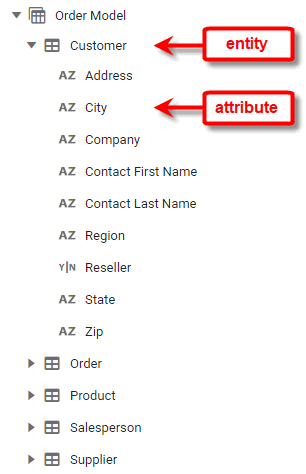
You should consider creating a data model if you have the following objectives:
-
Reduce the number of individual queries that need to be created and maintained
-
Provide self-service access to business users
-
Provide a simplified view of data that reduces data misrepresentation
-
Allow data to be filtered on fields that are not included in a Dashboard
-
Avoid the need for users to perform joins
Create a Data Model
| Data models are available only for relational data sources. Data models are not available for the ‘Hadoop Hive’ data source. |
A data model comprises a physical view and logical model:
-
Physical View: A physical view specifies a subset of database tables and the join relationships between them, covering all or part of the database schema. The physical view transforms the original database schema into a business intelligence-friendly schema, which can then be exposed to designers and end users through one or more logical models. See Physical View for information on constructing a physical view.
-
Logical Model: A logical model is based on a single physical view, and presents a business-oriented, easy-to-understand representation of the physical view by mapping database tables into entities and columns into attributes. The logical model denormalizes the data (adds additional redundancy) in order to maximize simplicity for data analysts and end users. See Logical Model for information on constructing a logical model.